How Are Mycotoxins Detected in Buildings?
Once homeowners learn about mycotoxins, the next question is usually straightforward. How do you know if they are present?
Unlike visible mould growth, mycotoxins cannot be identified by looking at a surface. They are microscopic compounds that require specialised laboratory analysis. This is where testing methods such as ELISA become relevant. Environmental professionals use these techniques to gather information about contamination within a property and better understand the conditions present inside a building.
If you are concerned about mould contamination, indoor air quality or potential mycotoxin exposure, Air Quality Australia can help determine whether environmental testing may be appropriate for your property. Selecting the right testing method is often one of the most important decisions during a mould investigation.
Why Isn’t a Visual Inspection Enough?
A visual inspection is usually the starting point of a mould investigation. Visible mould, water staining, damaged building materials and moisture issues can all provide valuable clues about what may be happening within a property.
However, visual observations have limitations. In many of the buildings we assess, contamination has developed within concealed spaces — wall cavities, roof spaces and subfloors — that a visual inspection alone would miss. Even when mould is visible, it may not be possible to determine whether fungal by-products such as mycotoxins are present without laboratory analysis.
What Questions Can Testing Help Answer?
Environmental testing is designed to provide information rather than assumptions. Depending on the circumstances, testing may help determine whether contamination is present, whether remediation has been successful or whether further investigation is required.
Testing is only one part of the process. Results should always be interpreted alongside building conditions, moisture findings and the overall context of the investigation. Laboratory reports provide data, but understanding what that data means requires experience and professional judgement.
What Is ELISA Testing?
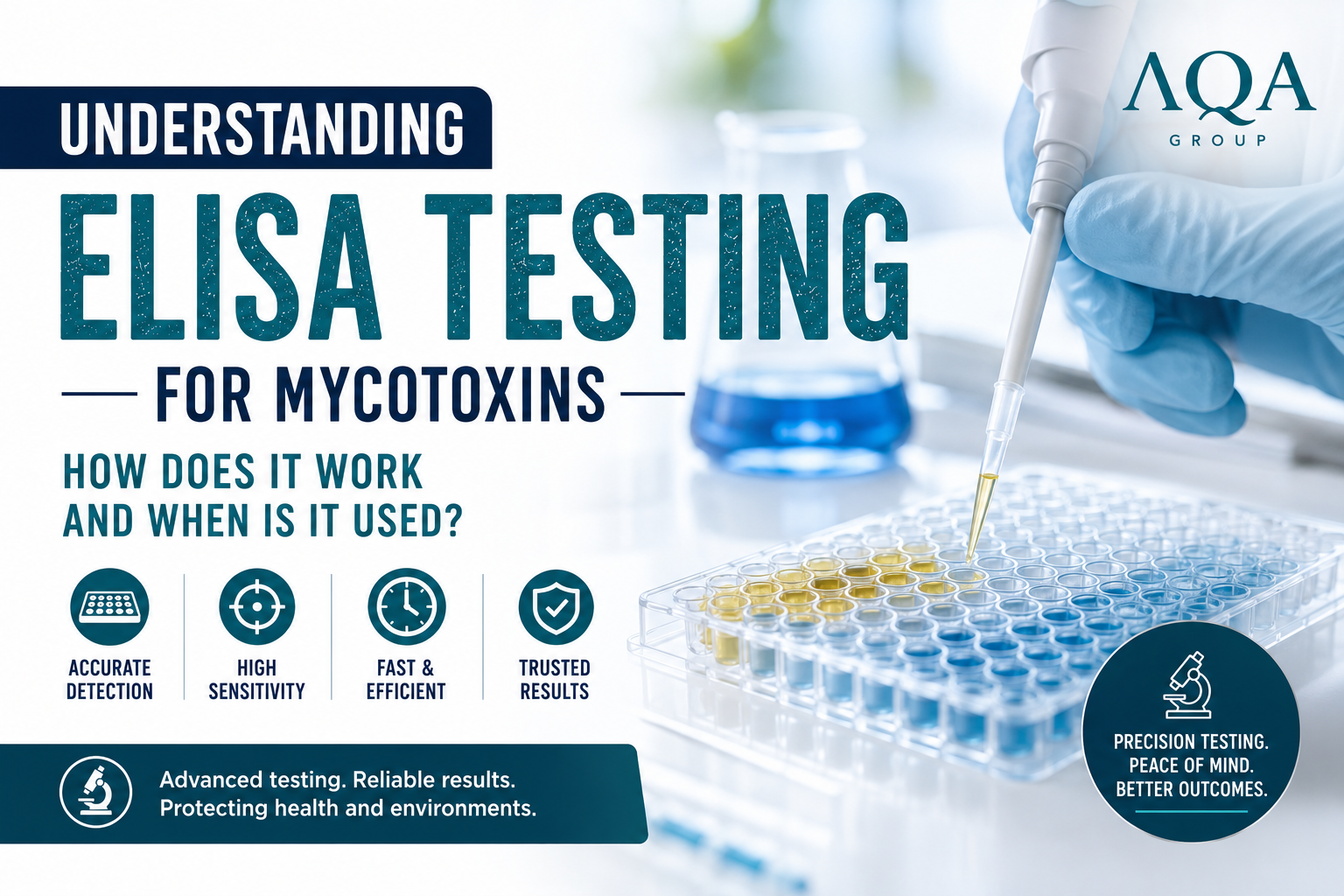
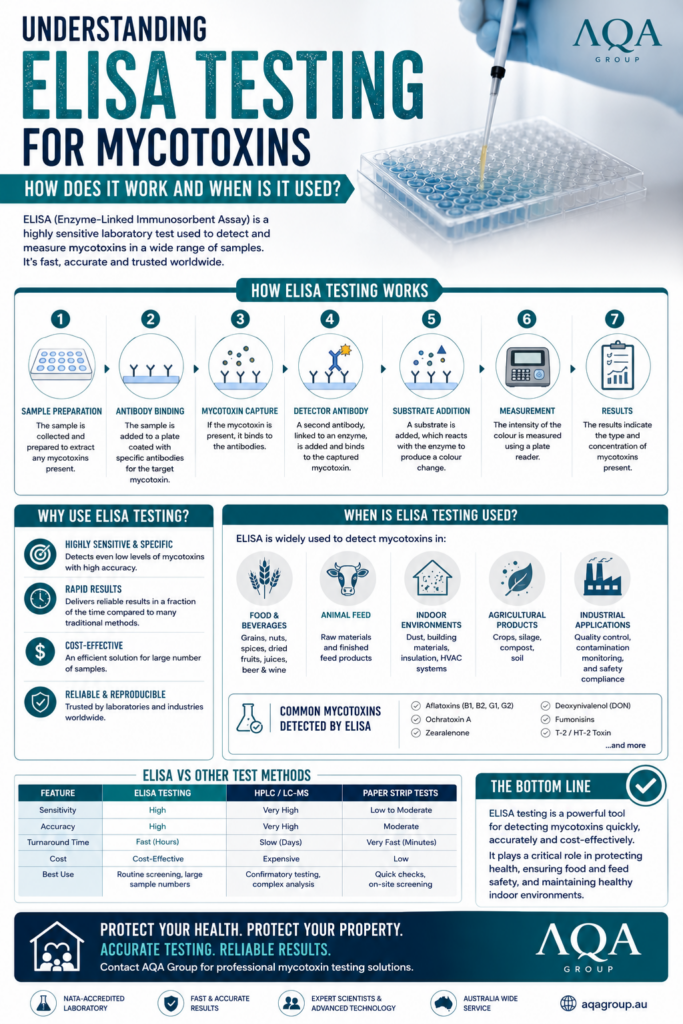
ELISA stands for Enzyme-Linked Immunosorbent Assay. While the name sounds highly technical, the underlying principle is relatively straightforward. ELISA is a laboratory method designed to identify specific substances by using antibodies that react to particular targets.
The technique has been used for decades in scientific, medical and environmental applications. In the context of mould investigations, ELISA testing can be used to identify and measure certain mycotoxins within environmental samples.
Why Is ELISA Commonly Used for Mycotoxin Testing?
One reason ELISA is widely used is its ability to detect specific compounds with a high degree of sensitivity. The method allows laboratories to analyse samples and determine whether particular mycotoxins are present above measurable levels.
Another practical advantage is efficiency. ELISA testing can process multiple samples within a relatively short timeframe, making it a workable option for environmental investigations where multiple locations or surfaces may need to be assessed.
Is ELISA Used Outside the Environmental Industry?
Yes. ELISA technology is used across a wide range of scientific disciplines, including medical diagnostics, food safety, pharmaceutical research and environmental science.
Its widespread use reflects the fact that ELISA is not a niche or experimental method. It is a well-established laboratory technique that has been refined and validated through many years of scientific application.
How Does ELISA Testing Work?
At its core, ELISA testing relies on antibodies designed to recognise specific target compounds. When a sample is analysed, these antibodies react if the target substance is present.
The laboratory then measures the reaction and compares it against known standards. This allows technicians to determine whether specific mycotoxins have been detected and at what concentration they may be present.
What Happens After a Sample Is Collected?
Before any laboratory analysis can occur, a sample must first be collected from the environment. Depending on the investigation, this may involve air sampling, dust sampling or surface sampling.
Once collected, the sample is carefully prepared and submitted to the laboratory. The testing process is then carried out under controlled conditions to ensure accuracy and consistency.
Why Is Laboratory Quality Important?
Not all testing is equal. Laboratory procedures, quality controls and analytical methods all influence the reliability of results.
For this reason, environmental professionals often work with laboratories that specialise in mould and mycotoxin analysis. Consistent procedures and validated testing methods help improve confidence in the results being reported.
When Might ELISA Testing Be Used?
ELISA testing is not required for every mould investigation. In many situations, visible mould growth and obvious moisture problems provide sufficient information to begin remediation without laboratory testing.
There are, however, circumstances where mycotoxin testing may help answer specific questions about the indoor environment. In our experience, the decision to use ELISA testing is always driven by the specific questions the investigation needs to answer — not by routine protocol.
Can ELISA Be Used During a Mould Investigation?
Yes. In some investigations, environmental professionals may use ELISA testing to better understand contamination within a property.
A building that has experienced extensive water damage, for example, may require additional information beyond what can be observed visually. Testing can support a broader assessment of the property and contribute meaningfully to the overall investigation strategy.
Is ELISA Useful After Remediation?
Post-remediation verification is another situation where testing may be considered.
After mould remediation has been completed, property owners often want reassurance that contamination has been effectively addressed. Testing can form part of a verification process designed to evaluate conditions following remediation work.
It is important to note that testing alone does not determine whether a remediation project has been successful. Results must always be interpreted alongside visual inspections, moisture assessments and other relevant findings.
What Are the Limitations of ELISA Testing?
Like all testing methods, ELISA has strengths and limitations. No laboratory test can answer every question about a building or indoor environment.
Understanding these limitations is important because it helps ensure results are interpreted appropriately and within the context of the overall investigation.
Can Testing Replace a Building Inspection?
No.
A laboratory result does not identify the source of moisture, explain why contamination developed or determine how water entered a building. Those questions require a thorough building assessment.
Testing should support an investigation, not replace it. The most effective environmental assessments combine laboratory data with practical building science knowledge.
Why Is Context So Important?
Results do not exist in isolation. A laboratory report is only one piece of a larger picture.
Experienced investigators consider moisture readings, building history, water damage events, ventilation issues and visible contamination when interpreting results. Looking at the full picture provides a far more accurate understanding of what is occurring within a property.
How Should Homeowners Approach Environmental Testing?
Homeowners are often exposed to conflicting information about mould testing. Some companies recommend extensive testing for every situation, while others dismiss testing entirely.
The reality is that testing has a role when it is used appropriately and interpreted correctly.
Should Every Property Be Tested?
Not necessarily.
If mould growth is clearly visible and the moisture source is obvious, remediation may be the immediate priority. Testing becomes more valuable when questions remain unanswered or when additional information is needed to support decision-making.
The goal should always be to collect information that helps solve a problem rather than simply generating more data.
How Can Homeowners Make Informed Decisions?
The most practical approach is to work with experienced professionals who understand both building science and environmental investigation.
A good investigator will explain why testing is being recommended, what information it may provide and how the results will be used. This helps homeowners make informed decisions based on evidence rather than fear or speculation.
Need Advice About Mould or Mycotoxin Testing?
Choosing the right testing strategy can be challenging, particularly when dealing with hidden mould, water damage or ongoing indoor air quality concerns.
Air Quality Australia provides professional inspections, environmental assessments and testing services designed to identify contamination issues and support evidence-based solutions. Contact our team to discuss your property and determine whether testing may be appropriate.
What Should You Read Next?
Now that you understand how ELISA testing works, the next question is whether air testing or surface testing is the most appropriate option for your situation.
Continue reading: Air Testing vs Surface Testing: Which Method Is Right for Detecting Mycotoxins?