
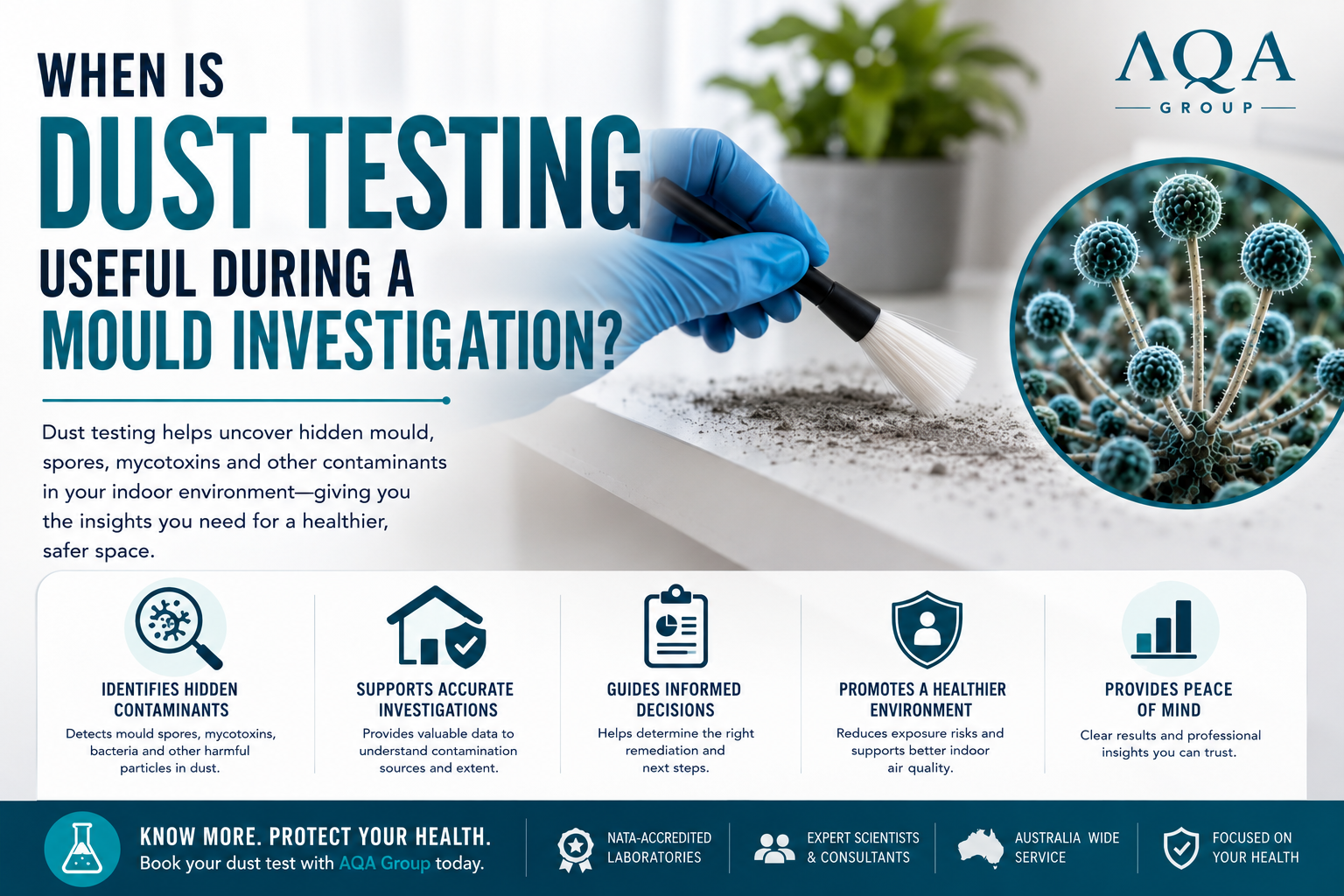
Could Household Dust Reveal Hidden Contamination?
When most people think about mould investigations, they picture air testing or visible mould growth on walls and ceilings. Few homeowners consider the role that household dust can play in understanding environmental conditions within a building. Yet dust is often one of the most overlooked sources of information during an investigation.
Every day, tiny particles settle onto surfaces throughout a home. Dust can contain fibres, pollen, skin cells, insect fragments, building materials and environmental contaminants. Over time, it effectively becomes a record of what has been occurring within the indoor environment. This is one reason why dust testing has become an increasingly valuable tool in certain mould investigations.
If you are concerned about mould growth, water damage or indoor air quality issues, Air Quality Australia can help determine whether dust testing may be appropriate for your property. Understanding when dust testing is useful can help homeowners make informed decisions and avoid unnecessary testing costs.
Why Is Dust Important During a Mould Investigation?
Dust does more than simply accumulate on shelves and skirting boards. As particles move through a building, they eventually settle onto surfaces and become part of the indoor dust load. This means dust can sometimes contain evidence of contamination that may not be immediately obvious through visual inspection alone.
Because dust accumulates over weeks, months and even years, it can provide a broader picture of environmental conditions than a single air sample taken at one point in time. For investigators attempting to understand the history of a property, this can be particularly valuable.
Why Don’t More Homeowners Know About Dust Testing?
Many homeowners are familiar with air testing because it is commonly discussed during mould investigations. Dust testing receives less attention despite being widely used in certain environmental assessment situations.
Part of the reason is that dust testing is often misunderstood. Some people assume it can answer every question about a building, while others dismiss it entirely. The reality sits somewhere in the middle. Dust testing can provide useful information when used appropriately, but it must always be considered alongside other investigative findings.
What Is Dust Testing?
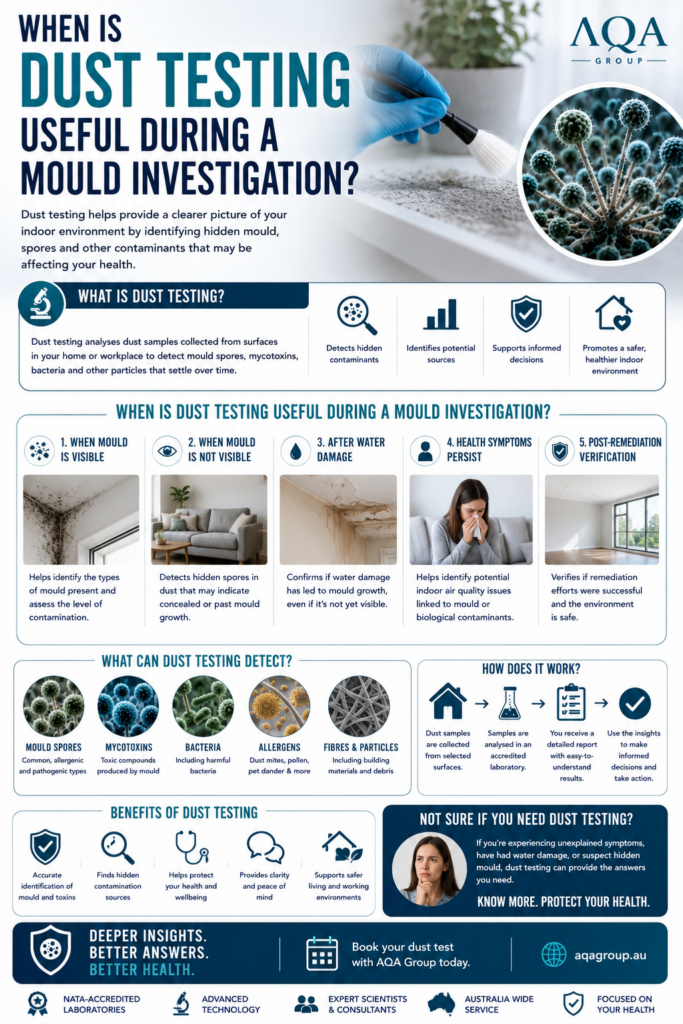
Dust testing involves collecting dust samples from a property and submitting them for laboratory analysis. The goal is to better understand what may have accumulated within the indoor environment over time.
Unlike air testing, which captures conditions at a specific moment, dust testing examines material that has been settling throughout the property over an extended period. This can sometimes reveal patterns that may not be obvious through other testing methods.
 How Are Dust Samples Collected?
The collection process varies depending on the testing method being used. Investigators may collect dust from specific surfaces, HVAC systems or other areas where dust naturally accumulates.
The location of the sample matters because different areas of a building may contain different types and concentrations of contamination. Experienced investigators select sampling locations based on the history of the property, the objectives of the investigation and evidence gathered during the inspection.
Why Does Sample Quality Matter?
As with any environmental testing, the quality of the sample directly affects the quality of the results. Poor sample collection techniques can produce misleading information and make interpretation more difficult.
Professional investigators follow established procedures to help ensure samples accurately represent the area being assessed. This helps improve confidence in the results and supports more meaningful conclusions.
What Can Dust Testing Reveal?
Dust testing may provide information about contamination that has accumulated within a building over time. Because dust acts as a collection point for particles moving throughout the indoor environment, it can sometimes reveal evidence of contamination that may not be obvious elsewhere.
This makes dust testing particularly useful in situations where homeowners suspect a problem exists but cannot identify a clear source of contamination.
Can Dust Testing Help Identify Hidden Mould Problems?
In some situations, yes.
A property may have recurring musty odours, ongoing indoor air quality concerns or a history of water damage without visible mould growth. Dust testing may contribute information that helps investigators determine whether contamination has been present within the indoor environment.
Dust testing should never be viewed as a shortcut to finding hidden mould, however. It is one tool that may support a broader investigation.
Can Dust Testing Reflect Long-Term Conditions?
One of the advantages of dust testing is that dust accumulates gradually. Unlike air samples, which provide information about a specific moment in time, dust may contain evidence of environmental conditions that have existed for much longer periods.
This can make dust testing useful when investigators are trying to understand whether contamination has been an ongoing issue within a property rather than a recent event. In some of the properties we assess, dust analysis provides context about contamination history that other testing methods alone may not have revealed.
When Might Dust Testing Be Appropriate?
Not every mould investigation requires dust testing. In many situations, visible mould growth, moisture measurements and building assessments provide sufficient information to identify the source of a problem.
There are circumstances, however, where dust testing may contribute valuable information and help investigators better understand environmental conditions within a property.
Is Dust Testing Useful When No Visible Mould Is Present?
Some of the most challenging investigations involve properties where occupants report concerns but visible mould cannot be found. We regularly assess properties in exactly this situation — musty odours, recurring moisture issues or indoor air quality concerns are present, yet no obvious source is identified during the initial inspection.
In these situations, dust testing may provide another source of information that contributes to the investigation. While it may not identify the exact location of a problem, it can sometimes help guide further assessment.
Can Dust Testing Be Useful After Remediation?
Following mould remediation, homeowners often want reassurance that contamination has been addressed properly. Dust testing may be considered as part of a post-remediation evaluation, particularly in properties that experienced extensive contamination.
When combined with visual inspections and moisture assessments, testing may contribute information that helps determine whether environmental conditions have improved following remediation efforts.
What Are the Limitations of Dust Testing?
Like every environmental testing method, dust testing has limitations. Understanding these limitations is essential for interpreting results accurately and avoiding unrealistic expectations.
The most effective investigations use testing as a tool rather than relying on it as the sole source of information.
Can Dust Testing Identify the Source of Moisture?
No.
Dust testing may provide information about contamination within the environment, but it cannot identify the source of a roof leak, plumbing failure or ventilation issue. Determining why contamination developed still requires a thorough building assessment.
This is why experienced investigators focus on both contamination and moisture. Identifying the source of water remains one of the most important steps in solving mould problems.
Does Dust Testing Represent an Entire Building?
Not necessarily.
The results only reflect the dust collected from the sampled area. Different rooms and areas within the same property may contain different contamination profiles depending on their history, usage and environmental conditions.
For this reason, sample selection and professional interpretation remain important parts of the process.
Can Dust Testing Replace Air Testing or Surface Testing?
Homeowners sometimes assume one testing method must be better than another. In reality, air testing, surface testing and dust testing each provide different types of information.
The best testing strategy depends on the goals of the investigation and the specific circumstances of the property.
How Does Dust Testing Compare to Air Testing?
Air testing provides information about airborne conditions at the time the sample is collected. Dust testing focuses on particles that have accumulated over a much longer period.
Because the two methods examine different aspects of the indoor environment, they may provide complementary information. One method does not automatically replace the other.
How Does Dust Testing Compare to Surface Testing?
Surface testing focuses on contamination present on a specific material or object. Dust testing evaluates material that has accumulated from across the indoor environment over time.
Depending on the investigation, both methods may provide useful information. The decision to use one or both approaches should be based on the questions investigators are attempting to answer.
Why Is Professional Interpretation So Important?
Laboratory results only tell part of the story. Understanding what those results mean requires experience, context and an understanding of building science.
Without proper interpretation, testing data can be misunderstood or lead homeowners towards incorrect conclusions about their property.
Can Dust Testing Results Be Misleading?
Any testing result can be misleading if viewed in isolation. Environmental conditions, building history, moisture findings and visual observations all contribute to understanding what results actually mean.
A laboratory report should never be interpreted without considering the broader context of the investigation.
How Can Homeowners Avoid Unnecessary Testing?
One of the concerns raised during discussions within the mould industry is the tendency for some companies to recommend extensive testing without first properly assessing the property itself.
A professional investigation should begin with the building, not the laboratory. Testing should only be recommended when it helps answer a meaningful question about the property and contributes to solving the problem.
How Can Air Quality Australia Help?
Every mould investigation is different. Some properties require extensive assessment, while others may only need a targeted inspection and moisture evaluation. Determining whether dust testing is appropriate depends on the circumstances of the building and the objectives of the investigation.
Air Quality Australia provides professional inspections, moisture assessments and environmental testing services designed to support evidence-based decisions. Our approach focuses on identifying the source of contamination and providing practical recommendations tailored to each property.
When Should You Contact a Professional?
If you are experiencing recurring mould growth, musty odours, water damage or concerns about hidden contamination, professional advice may help identify the cause of the problem before it becomes more extensive.
Early investigation often prevents small moisture issues from developing into larger contamination events, helping homeowners protect both their property and indoor environment.
What Should You Read Next?
Now that you understand when dust testing may be useful, the next step is exploring one of the more complex topics discussed in the podcast: masked mycotoxins and why they continue to attract attention within environmental and scientific communities.
Continue reading: What Are Masked Mycotoxins and Why Are Researchers Paying Attention?