
Have You Started Hearing Terms Like ELISA During a Mould Investigation?
If you are concerned about mould contamination, water damage or indoor air quality issues, Air Quality Australia can help determine the most appropriate investigation strategy for your property. Understanding the purpose behind different testing methods can make the process far less confusing.
For many families, the journey into mould investigations begins unexpectedly. A water leak is discovered. A musty smell develops inside the home. Visible mould appears on a wall or ceiling. In some cases, family members begin wondering whether their environment could be contributing to ongoing health concerns.
Once that journey starts, homeowners often find themselves researching topics they have never encountered before. They listen to podcasts, read articles, join online discussion groups and speak with professionals. Before long, unfamiliar terms begin appearing everywhere. Suddenly people are hearing words like mycotoxins, air sampling, dust testing, AMEA, MESA and ELISA.
One of the terms that often causes confusion is ELISA. The name sounds highly technical and scientific, which can make it difficult for homeowners to understand why it matters. However, the reason laboratories use ELISA is actually quite straightforward. It is simply a tool designed to help identify specific compounds within environmental samples.
Why Does Mould Testing Become So Complicated?
One of the challenges homeowners face is that mould investigations often involve multiple disciplines. Building science, moisture assessment, laboratory analysis and remediation all come together during the investigation process.
As a result, families are often exposed to technical language that professionals use every day but which may be completely unfamiliar to the average homeowner. Understanding a few of these terms can make it much easier to follow recommendations and make informed decisions during an investigation.
Why Are More People Hearing About ELISA?
Part of the reason ELISA receives attention is because mycotoxins have become a more widely discussed topic within the mould industry. As awareness of mould contamination grows, more people are seeking information about how environmental samples are analysed and what testing methods laboratories use.
While homeowners may never need to understand every detail of the laboratory process, having a basic understanding of ELISA can help explain how certain types of mycotoxin testing are performed.
What Is ELISA Testing?
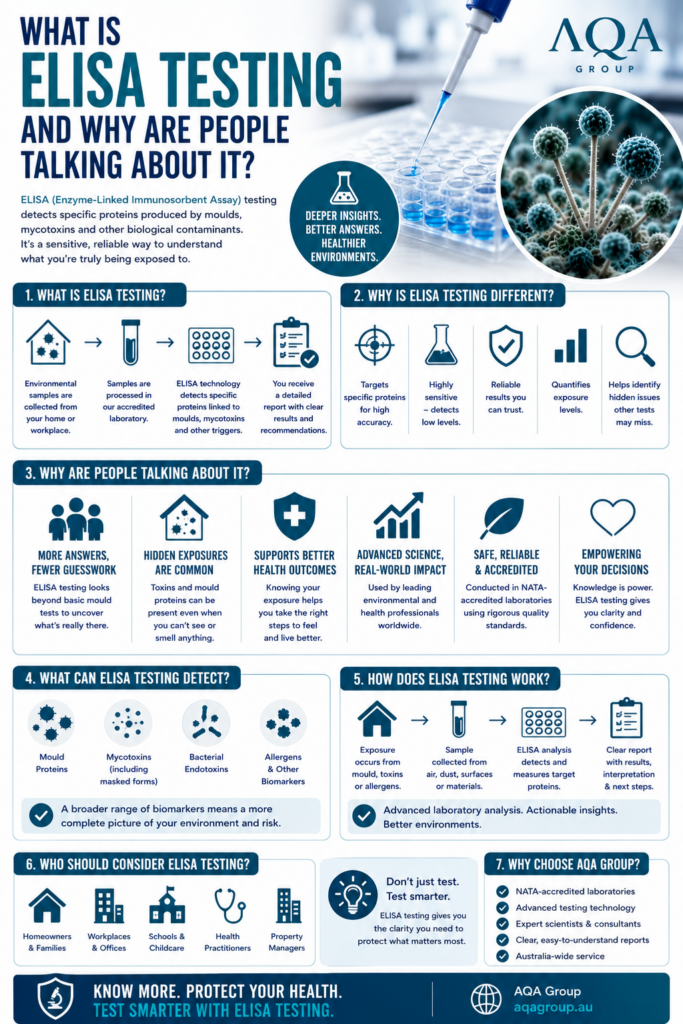
ELISA stands for Enzyme-Linked Immunosorbent Assay. While the name sounds complex, the purpose of the test is relatively simple. It is a laboratory method used to identify specific substances within a sample.
The technology has been used for decades across a variety of scientific fields. Medical researchers, food safety laboratories, environmental scientists and pharmaceutical companies all use ELISA for different purposes. In the mould industry, ELISA is commonly used to help identify specific mycotoxins within environmental samples.
Why Do Laboratories Use ELISA?
Laboratories use ELISA because it is designed to identify particular compounds with a high degree of specificity. Rather than searching for every substance within a sample, the method focuses on detecting the compounds it has been designed to identify.
This targeted approach makes ELISA useful for certain types of environmental testing. It allows laboratories to analyse samples efficiently and provide information that may contribute to a broader mould investigation.
Is ELISA Only Used for Mould Testing?
Not at all.
In fact, most people have probably benefited from ELISA technology without ever realising it. Variations of the method are used in medical diagnostics, food testing and scientific research around the world.
Its widespread use is one reason it has become an established laboratory technique. It is not a new or experimental process. It is a well-known analytical method that has been refined and utilised for many years.
How Does ELISA Testing Work?
Most homeowners do not need to understand every technical detail of the laboratory process. However, understanding the basic concept can help explain why the method is useful.
ELISA works by using specially developed antibodies that react to specific target compounds. If the target substance is present within the sample, a reaction occurs that allows laboratory analysts to identify and measure it.
Why Is This Useful for Mycotoxin Analysis?
Mycotoxins are microscopic compounds. They cannot be identified simply by looking at a sample with the naked eye. Detecting them requires specialised laboratory methods designed to recognise specific substances.
This is where ELISA becomes useful. It provides laboratories with a method of determining whether particular mycotoxins are present within a sample submitted for analysis.
Does ELISA Provide All the Answers?
No.
One of the most important things Graham Singleton and Jason Chapple often explain is that testing should never be viewed as the entire investigation. A laboratory result is only one piece of the puzzle.
Understanding why contamination developed, where moisture entered the building and how contamination may have spread still requires building assessments, moisture investigations and professional interpretation. Testing provides information, but it does not replace the investigation itself.
Why Did Investigators Become Interested in Testing Methods Like ELISA?
Experienced mould investigators are always looking for better ways to understand what is happening within a property. Every building is different, and some contamination issues are far more complex than others.
Over the years, investigators have used a wide range of tools including moisture meters, thermal imaging cameras, air sampling, surface sampling and dust analysis. As laboratory technology has evolved, additional testing methods have become available to support these investigations.
What Questions Are Investigators Trying to Answer?
In many cases, investigators already know a property has experienced moisture problems. The real challenge is understanding the extent of contamination and determining the most appropriate course of action.
Testing methods such as ELISA may help provide additional information that contributes to this process. The results are considered alongside building conditions, moisture findings and other investigative observations.
Why Isn’t Testing Used on Every Property?
Not every mould problem requires laboratory analysis.
Sometimes the source of contamination is obvious. A roof leak, plumbing failure or visible mould growth may already provide enough information to begin corrective action. In these situations, identifying and addressing the moisture source is often more important than additional testing.
The decision to perform testing should always be based on the goals of the investigation rather than a desire to collect laboratory reports.
What Are the Advantages of ELISA Testing?
Like any analytical method, ELISA has strengths that make it useful in certain situations. Its widespread use reflects the fact that it has proven effective for many laboratory applications.
Understanding these strengths helps explain why laboratories continue to utilise the method today.
Is ELISA a Well-Established Technology?
Yes.
One of the major advantages of ELISA is that it has been used extensively across multiple scientific disciplines. Laboratories are familiar with the methodology and understand how to apply it to a variety of analytical situations.
Its long history of use provides confidence in the process and contributes to its continued popularity within laboratory environments.
Can ELISA Produce Useful Information Quickly?
Compared with some analytical methods, ELISA can provide an efficient way to analyse samples for specific target compounds.
This efficiency is one reason it remains widely used. However, as with any testing method, the value of the results depends on how they are interpreted within the broader context of the investigation.
What Are the Limitations of ELISA Testing?
No testing method is perfect. Understanding the limitations of laboratory analysis is just as important as understanding its benefits.
Homeowners sometimes assume testing will provide definitive answers about every aspect of a mould problem. In reality, environmental investigations are rarely that simple.
Can ELISA Identify the Source of Moisture?
No.
Laboratory testing may identify compounds within a sample, but it cannot determine why moisture entered a building or where contamination originated. Those questions require building science expertise and a thorough investigation of the property.
This is why moisture assessments remain one of the most important parts of any mould investigation.
Why Is Professional Interpretation So Important?
Laboratory reports contain data. Understanding what that data means requires experience and context.
Results should always be considered alongside visual inspections, moisture measurements, building history and other investigative findings. Looking at the complete picture generally provides a much better understanding of the property than focusing on a single laboratory result.
How Can Air Quality Australia Help?
Understanding mould contamination often requires more than laboratory testing alone. Identifying moisture sources, evaluating building conditions and selecting appropriate investigative tools all play important roles in resolving contamination issues.
Air Quality Australia provides professional inspections, moisture assessments and evidence-based investigations designed to help homeowners understand what is happening within their properties. Our approach focuses on practical solutions supported by building science and real-world experience.
When Should You Contact a Professional?
If you are dealing with recurring mould growth, water damage, indoor air quality concerns or uncertainty about contamination within your property, professional advice may help clarify the situation and identify the most appropriate next steps.
Early investigation often prevents small moisture issues from becoming larger and more expensive problems.
What Should You Read Next?
Now that you understand what ELISA testing is and why laboratories use it, the next step is learning about AMEA testing and why it has attracted attention within the mould investigation industry.
Continue reading: What Is AMEA Testing and Why Are People Talking About It?