Should You Choose Air Testing or Surface Testing?
One of the most common questions we hear during a mould investigation is whether air testing or surface testing is the better option. The answer is not straightforward. Both methods can provide useful information, but they are designed to answer different questions.
If you’re dealing with mould contamination, water damage or concerns about mycotoxin exposure, the testing approach matters. Choosing the right method can provide meaningful, actionable information. Choosing the wrong one can result in unnecessary expense and results that do little to help identify the underlying problem.
Understanding the strengths and limitations of each approach is the first step toward a testing strategy that actually serves the investigation.
Why Is There No One-Size-Fits-All Approach?
Every building is different. A property with visible mould growth on a wall requires a different investigation strategy than a home with a musty odour and no visible signs of contamination. The age of the building, its construction methods, moisture history and occupancy patterns can all influence which testing method is most appropriate.
Experienced investigators assess the building first and then determine which tools are most likely to provide meaningful information. Testing should support the investigation — not drive it.
What Questions Should Testing Answer?
Before any testing is performed, it helps to identify the questions that need answering. Are you trying to locate hidden contamination? Are you assessing airborne conditions in occupied spaces? Has remediation already been completed and verification is required?
The answers will often determine whether air testing, surface testing or a combination of both is the right approach. Establishing the objective of the investigation is one of the most important steps in obtaining results that are actually useful.
What Is Air Testing?
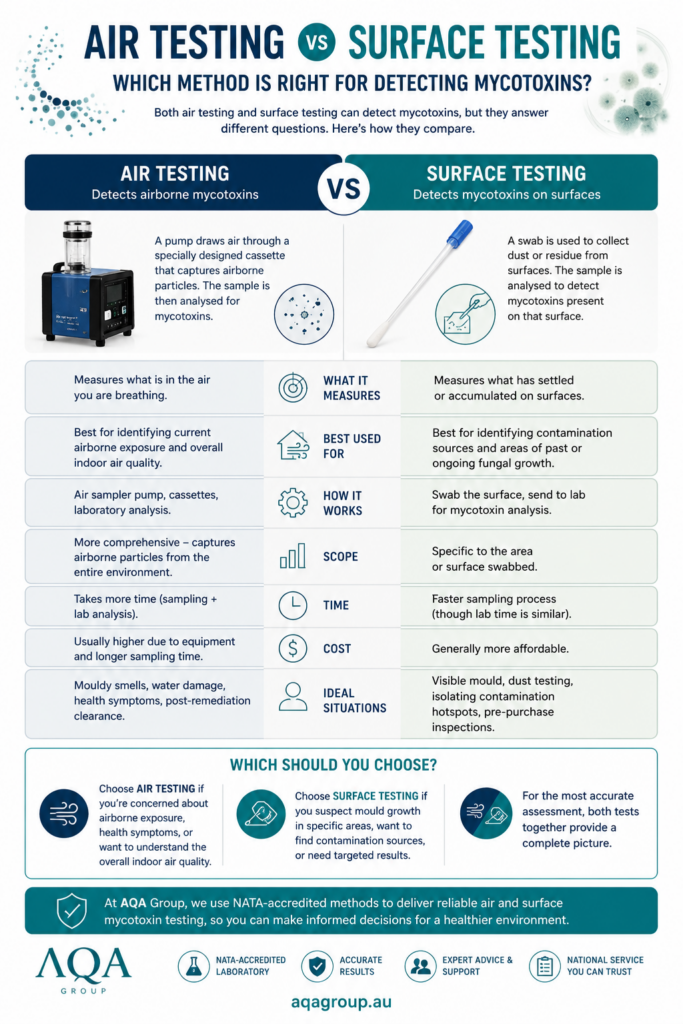
Air testing involves collecting samples from the indoor environment and analysing what is present in the air at the time the sample is taken. Depending on the investigation, air testing may focus on mould spores, particulates or specific environmental contaminants.
When investigating mycotoxins, specialised air testing methods may be used to evaluate airborne contamination within a building. These methods help investigators understand what occupants may be exposed to under normal living conditions.
What Information Can Air Testing Provide?
Air testing provides a snapshot of conditions within a property at a specific point in time. It may help identify airborne contamination that cannot be detected during a visual inspection and can assist investigators when assessing indoor environmental quality.
Air testing is also useful when occupants report concerns despite the absence of visible mould growth. In these situations, results may help guide further investigation and assist in identifying potential contamination pathways within the building.
What Are the Limitations of Air Testing?
Air testing only reflects conditions at the moment the sample is collected. Airborne contamination levels can change throughout the day depending on weather conditions, occupant activities, ventilation and airflow patterns.
For this reason, air testing should never be viewed as a standalone answer. Results need to be interpreted alongside visual inspections, moisture assessments and an understanding of the building itself. Air testing provides valuable information, but it is one piece of a much larger picture.
What Is Surface Testing?
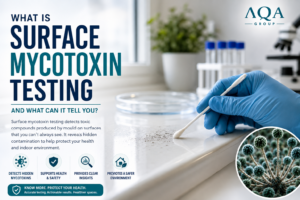
Surface testing involves collecting samples directly from building materials, furnishings or other surfaces within a property. The purpose is to determine whether contamination is present on a specific surface or within a specific area.
In the context of mycotoxin investigations, surface testing may be used to assess contamination that has settled onto materials over time. Unlike air testing, which evaluates airborne conditions, surface testing focuses on contamination that is physically present on the sampled surface.
What Information Can Surface Testing Provide?
Surface testing can help identify contamination in areas where mould growth is visible or suspected. It can also be useful when investigators want to understand whether specific building materials have been affected.
Because contamination can settle onto surfaces over time, surface testing may provide useful information about areas that have experienced ongoing exposure. This makes it particularly relevant when assessing water-damaged materials or evaluating the effectiveness of remediation work.
What Are the Limitations of Surface Testing?
Surface testing only reflects the specific area that was sampled. A result from one surface does not represent conditions throughout the entire property.
Surface testing also provides no direct information about airborne contamination. A surface may show evidence of contamination while air samples indicate different conditions. This is why testing methods need to be selected carefully based on the goals of the investigation.
When Might Air Testing Be the Better Choice?
Air testing is often considered when investigators want to understand airborne conditions within occupied spaces. It can be particularly useful when contamination is suspected but cannot be visually identified.
Properties with persistent musty odours, unexplained indoor air quality concerns or suspected hidden mould may benefit from air testing as part of a broader investigation strategy.
Can Air Testing Help Locate Hidden Problems?
In some situations, air testing may provide clues that support further investigation. Elevated airborne contamination levels can indicate the presence of hidden mould growth or moisture-related issues within the building.
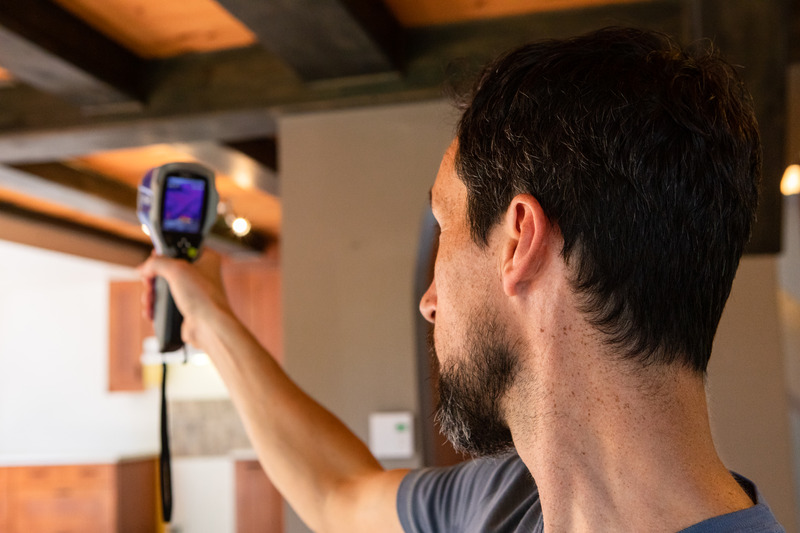
However, air testing alone rarely pinpoints the exact location of a problem. Results should be used alongside moisture assessments, thermal imaging and visual inspections to build a complete picture of the property.
Is Air Testing Useful After Water Damage?
Following significant water damage, air testing may help investigators assess conditions within the property. This can be relevant when occupants remain concerned about indoor environmental quality after drying and remediation work has been completed.
As with any testing method, the results are most useful when interpreted within the broader context of the investigation.
When Might Surface Testing Be the Better Choice?
Surface testing is often useful when investigators need information about a specific area, material or surface. It may be appropriate when visible contamination is present or when questions exist about the condition of particular building components.
Because the testing is targeted, it can provide detailed information about the area being assessed. This makes it a valuable tool in the right circumstances.
Can Surface Testing Confirm Contamination?
Surface testing can help identify contamination on a sampled material. It may be used to assess walls, ceilings, furnishings, flooring materials or other surfaces where contamination is suspected.
The results contribute to a better understanding of conditions within the building. They should still be interpreted alongside moisture findings, visual observations and other relevant information.
Is Surface Testing Useful After Remediation?
Many investigators use surface testing as part of post-remediation verification. Testing specific areas can help determine whether contamination remains on surfaces following remediation work.
As with all environmental testing, the goal is not simply to obtain laboratory results. The objective is to gather information that helps evaluate whether remediation has been effective and supports informed decision-making.
Can Air Testing and Surface Testing Be Used Together?
In many investigations, the most effective approach is not choosing one method over the other. Both methods may be used together to build a more complete understanding of the property.
Air testing and surface testing provide different types of information. Used together, they can complement each other and help answer questions that a single testing method may not resolve.
Why Do Some Investigations Use Multiple Testing Methods?
Complex contamination issues often require multiple sources of information. Moisture assessments, visual inspections, air testing and surface testing can each contribute something the others cannot.
Using several investigative tools reduces reliance on any single result. It also improves the ability to identify contamination pathways, moisture sources and areas requiring further attention. In our experience, investigations that rely on a single testing method — without broader context — are more likely to produce incomplete or misleading conclusions.
Does More Testing Always Mean Better Results?
Not necessarily.
One of the challenges within the mould industry is the assumption that more testing automatically produces better answers. In practice, unnecessary testing increases costs without improving the quality of the investigation.
The most effective approach is targeted testing based on evidence. Every sample collected should have a clear purpose and contribute to answering a specific question.
How Do You Choose the Right Testing Strategy?
Choosing the right testing strategy starts with understanding the building itself. Moisture history, visible damage, occupant concerns and environmental conditions all influence which testing methods are appropriate.
Rather than selecting tests first and asking questions later, experienced investigators assess the property and develop a strategy based on the evidence in front of them.
Why Does Professional Guidance Matter?
Environmental testing can generate a significant amount of data. Interpreting that data correctly requires experience and a solid understanding of building science, moisture dynamics and contamination pathways.
A qualified investigator can explain which testing methods are appropriate, why they are being recommended and how the results will be used during the investigation.
How Can Homeowners Avoid Unnecessary Testing?
Be cautious of anyone recommending extensive testing before they have actually assessed the property. A professional investigation should begin with a thorough look at the building, not a list of laboratory tests.
The goal is not to collect as many samples as possible. The goal is to identify the source of the problem and provide practical recommendations based on evidence. Many property owners are surprised to find that a well-structured visual and moisture assessment can answer most of their questions before a single laboratory sample is needed.
Need Help Choosing Between Air Testing and Surface Testing?
If you are dealing with mould contamination, water damage or indoor air quality concerns, Air Quality Australia can help determine the most appropriate testing strategy for your property.
Our team provides professional inspections, environmental assessments, air testing and surface testing designed to deliver meaningful information and support evidence-based solutions.
What Should You Read Next?
Now that you understand the differences between air testing and surface testing, the next step is learning more about air mycotoxin testing and how AMEA testing may be used during a mould investigation.
Continue reading: What Is Air Mycotoxin Testing and When Should It Be Used?